
01 / 09
Radineer / Services
AI x RPA Business Automation Consulting
AI-RPA is a service that combines generative AI with RPA (Robotic Process Automation) to automate both routine and non-routine tasks.
 View larger image
Inquire about AI x RPA Business Automation Consulting
02 / 09
Choose the scope you need.
Accounting & Invoicing
HR & Attendance Management
Sales & CRM Updates
 View larger image
03 / 09
How we work.
- 1
Business Inventory & Automation Assessment
- Interview and visualize current business processes, identify automation targets and priorities for both RPA and AI. Deliver ROI estimation report.
- 2
Automation Design & PoC
- Design automation scenarios and conduct PoC for 1-2 processes. Quantitatively verify effectiveness for full-scale deployment decisions.
- 3
Development & Testing
- 4
Operations & Expansion
- Continue operational monitoring and maintenance while gradually expanding automation scope. Maximize automation effectiveness with KPI management and improvement proposals.
04 / 09
The support you need, one piece at a time.
Scope
- Accounting & Invoicing
- HR & Attendance Management
- Sales & CRM Updates
- Customer Support
- 01
Accounting & Invoicing
- 02
HR & Attendance Management
- 03
Sales & CRM Updates
- 04
Customer Support
05 / 09
What we actually do.
- 01
Automate invoice scanning, data entry, journal entries, and payment processing with AI-OCR and RPA.
- 02
Automate attendance data aggregation, payroll calculation, onboarding/offboarding procedures, and document creation with RPA. Anomaly detection handled by AI.
- 03
Automate business card registration, CRM data updates, meeting notes organization, and follow-up email delivery.
06 / 09
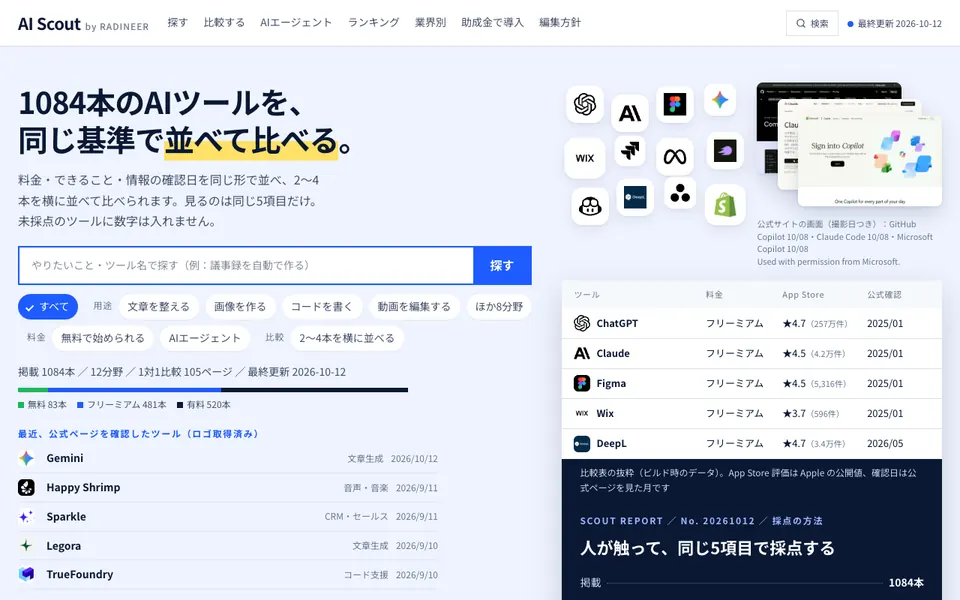
See our own work.
See our work through the services and screens we've published.
Our public service
Our AI SaaS comparison service07 / 09
Pricing and terms.
Automation Assessment
From ¥300,000
Analyze business processes and report automation priorities, expected impact, and estimated costs.
PoC & Small-Scale Automation
From ¥1,000,000
Conduct PoC on 1-2 processes to validate automation effectiveness.
Full-Scale Implementation
From ¥3,000,000
Design, develop, test, and deploy automation for multiple processes.
Monthly Operations & Maintenance
From ¥200,000/month
Ongoing operational monitoring, maintenance, and improvement proposals for automation robots.
Compare plans side by side
Compare by cost and what is included. On a phone, scroll sideways.
| Item | Automation Assessment | PoC & Small-Scale Automation | Full-Scale Implementation | Monthly Operations & Maintenance |
|---|---|---|---|---|
| Price | From ¥300,000 | From ¥1,000,000 | From ¥3,000,000 | From ¥200,000/month |
| What is included & terms | Analyze business processes and report automation priorities, expected impact, and estimated costs.
| Conduct PoC on 1-2 processes to validate automation effectiveness.
| Design, develop, test, and deploy automation for multiple processes.
| Ongoing operational monitoring, maintenance, and improvement proposals for automation robots.
|
09 / 09
Before you get in touch.
What can I consult you about?
You can consult us about: Accounting & Invoicing, HR & Attendance Management, Sales & CRM Updates, Customer Support, Data Aggregation & Reporting, Contracts & Document Processing.
What are your pricing plans?
Automation Assessment: From ¥300,000. PoC & Small-Scale Automation: From ¥1,000,000. Full-Scale Implementation: From ¥3,000,000. Monthly Operations & Maintenance: From ¥200,000/month.
How does the engagement work?
We proceed in this order: Business Inventory & Automation Assessment → Automation Design & PoC → Development & Testing → Operations & Expansion.
Inquire about AI x RPA Business Automation Consulting
Tell us about your challenges and goals.
Inquire about AI x RPA Business Automation Consulting
Read details on services and pricing
What is included
Accounting & Invoicing
Automate invoice scanning, data entry, journal entries, and payment processing with AI-OCR and RPA.
HR & Attendance Management
Automate attendance data aggregation, payroll calculation, onboarding/offboarding procedures, and document creation with RPA. Anomaly detection handled by AI.
Sales & CRM Updates
Automate business card registration, CRM data updates, meeting notes organization, and follow-up email delivery.
Customer Support
Handle common inquiries with automated responses, ticket classification, and escalation decisions using AI chatbots.
Data Aggregation & Reporting
Automate data collection, aggregation, report creation, and distribution. Includes AI-powered anomaly detection and trend analysis.
Contracts & Document Processing
Automate contract review, clause checking, document classification, and data extraction with AI-NLP and RPA.
How we work, in detail
Business Inventory & Automation Assessment
Interview and visualize current business processes, identify automation targets and priorities for both RPA and AI. Deliver ROI estimation report.
Automation Design & PoC
Design automation scenarios and conduct PoC for 1-2 processes. Quantitatively verify effectiveness for full-scale deployment decisions.
Development & Testing
Operations & Expansion
Continue operational monitoring and maintenance while gradually expanding automation scope. Maximize automation effectiveness with KPI management and improvement proposals.
Pricing & plan details
Automation Assessment: From ¥300,000
Analyze business processes and report automation priorities, expected impact, and estimated costs.
- Business process inventory & hearings
- Identification of automation targets
- Priority & ROI estimation
- Automation design document (overview)
PoC & Small-Scale Automation: From ¥1,000,000
Conduct PoC on 1-2 processes to validate automation effectiveness.
- PoC execution for target processes
- RPA / AI robot development
- Effectiveness measurement report
- Full-scale implementation decision support
Full-Scale Implementation: From ¥3,000,000
Design, develop, test, and deploy automation for multiple processes.
- Automation design & development
- Multi-process batch deployment
- Operations manual creation
- Internal training
Monthly Operations & Maintenance: From ¥200,000/month
Ongoing operational monitoring, maintenance, and improvement proposals for automation robots.
- Operational monitoring & incident response
- Scheduled maintenance
- Improvement proposals & feature additions
- Reporting & KPI management